

-new.webp?width=389&height=260&name=network-switch-with-cables%20(2)-new.webp)


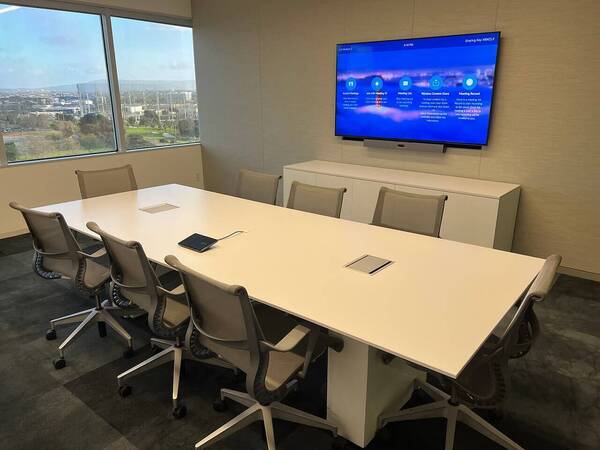
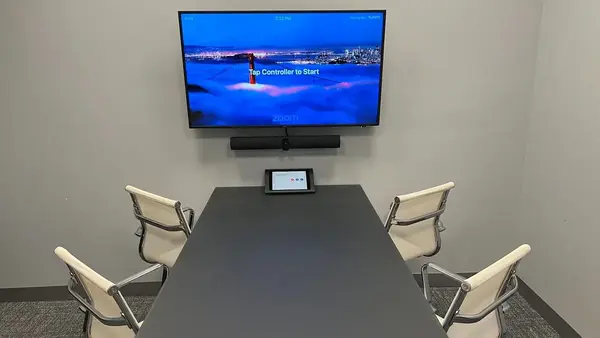
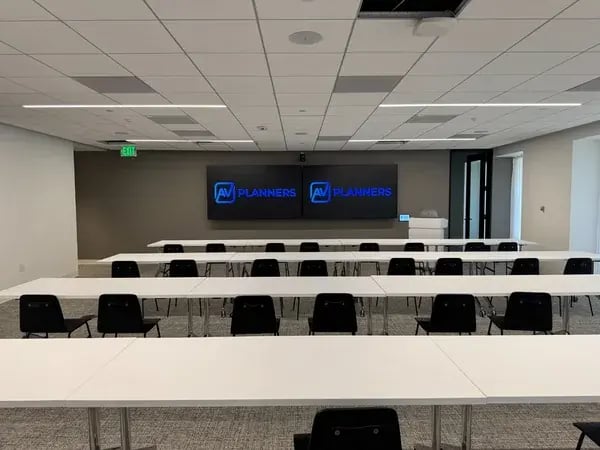
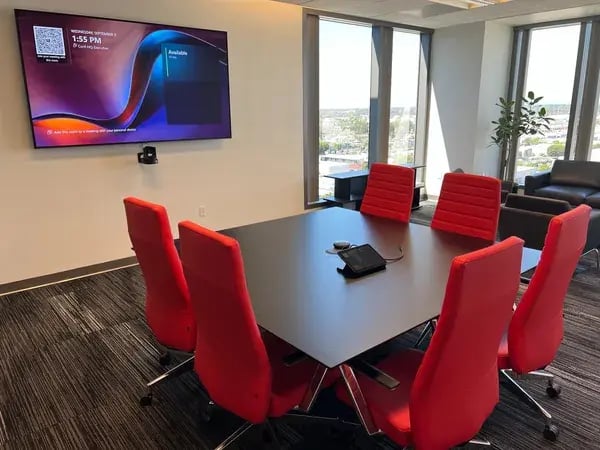

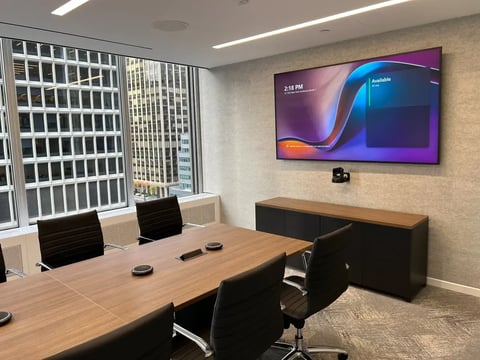
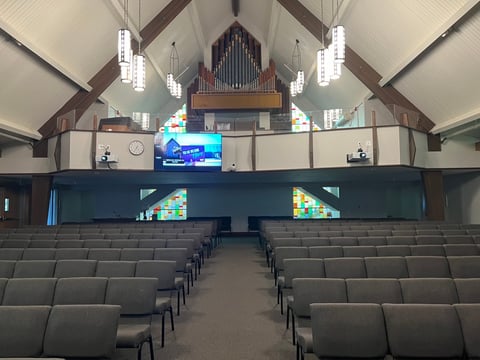
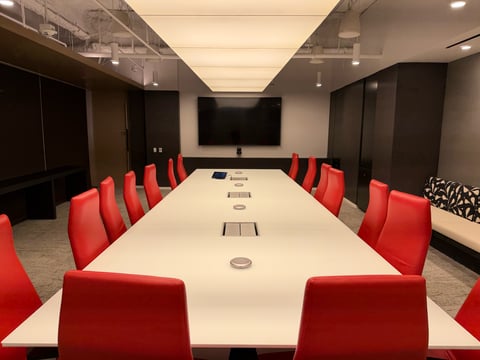
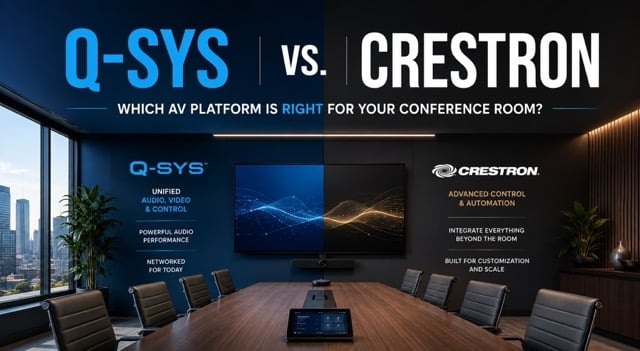
When designing a modern conference room, executive boardroom, training space, or enterprise AV system, two platforms frequently come up: Q-SYS and Crestron.
Both are powerful professional AV platforms, but they have different strengths.
Q-SYS has become an increasingly attractive platform for modern commercial AV environments, particularly conference rooms, Microsoft Teams Rooms, Zoom Rooms, advanced audio systems, and network-based AV deployments.
Crestron remains a major force in control and automation, particularly for highly customized systems, building automation, and luxury residential applications.
So which one should you choose?
The answer depends less on which platform is "better" and more on what you're trying to accomplish, what infrastructure you already have, and how you want to manage the system long term.
At AV Planners, we design and integrate commercial AV systems in Los Angeles and Southern California while also supporting clients with projects across multiple U.S. markets. Here's how we look at Q-SYS versus Crestron when helping clients evaluate their options.
Q-SYS vs. Crestron: The Short Answer
If you're primarily designing corporate conference rooms, collaboration spaces, boardrooms, training rooms, or standardized AV environments across multiple offices, Q-SYS deserves serious consideration.
Its software-based architecture combines audio, video, and control within a unified platform and fits naturally into increasingly network-centric corporate IT environments.
Crestron may be particularly attractive when a project requires extensive custom control and automation across AV, lighting, shades, HVAC, environmental controls, and other building systems.
Crestron also has a particularly strong presence in luxury residential automation, where homeowners may want one platform controlling technology throughout an entire residence.
For many projects, however, the decision isn't strictly Q-SYS or Crestron. Existing infrastructure and specific room requirements can matter as much as the platform itself.
Where Q-SYS Excels
One of Q-SYS's biggest advantages is its unified approach to professional AV.
Traditionally, a sophisticated conference room might have separate systems for audio DSP, control, video distribution, cameras, monitoring, and other functions.
Q-SYS can bring many of these capabilities together within the same ecosystem.
Depending on the design, a Q-SYS system can provide:
- Audio DSP and acoustic echo cancellation
- Room control and automation
- Video distribution
- Camera control and switching
- Network audio and video
- Touchscreen user interfaces
- USB connectivity
- System monitoring and remote management
This unified architecture can be particularly valuable when organizations want to standardize conference-room technology across multiple rooms or offices.
Q-SYS Is Designed Around Modern Networked AV
Corporate AV has increasingly become part of the IT infrastructure.
Audio, video, cameras, control systems, conferencing devices, and monitoring tools are increasingly connected over standard IP networks.
Q-SYS fits naturally into this environment.
Rather than treating the AV system as an isolated collection of specialized boxes, Q-SYS uses a software-based architecture that lets many AV functions run on a common networked platform.
For IT departments responsible for dozens—or potentially hundreds—of meeting spaces, this can make system standardization and management easier.
Q-SYS for Microsoft Teams Rooms and Zoom Rooms
For many companies today, the conference platform is the room's center.
Employees don't necessarily care what AV processor is installed in the rack.
They want to walk into a room, tap Join, and have the meeting work.
Q-SYS can be integrated into professional Microsoft Teams Rooms and Zoom Rooms while providing capabilities that go well beyond a basic all-in-one conferencing appliance.
For example, a larger Q-SYS conference room might incorporate:
- Multiple professional cameras
- Automatic camera switching
- Ceiling or table microphones
- Professional loudspeakers
- Acoustic echo cancellation
- Touchscreen room control
- Content sharing
- Automated room functions
That makes Q-SYS particularly useful when an organization wants the simplicity of Teams or Zoom combined with the performance of a professionally engineered AV system.
Audio and DSP Are Major Q-SYS Strengths
Audio quality is one of the most important—and sometimes overlooked—parts of a conference-room experience.
A beautiful 98-inch display doesn't matter much if remote participants can't understand the people sitting around the table.
Q-SYS has deep roots in professional audio and DSP, and those capabilities remain central to the platform.
Depending on the application, a Q-SYS system can incorporate technologies such as:
- Acoustic echo cancellation
- Automatic microphone mixing
- Shure ceiling and table microphones
- Dante network audio
- Voice reinforcement
- Multiple speaker zones
- Audio processing
- Microphone-driven camera switching
These capabilities become particularly valuable in executive boardrooms, training rooms, large conference rooms, divisible spaces, and other acoustically challenging environments.
Where Crestron Excels
Crestron has been a leading name in professional control and automation for decades.
One of its biggest strengths is creating highly customized control environments.
Crestron can integrate AV technology with many other systems, including:
- Displays
- Video conferencing
- Lighting
- Motorized shades
- HVAC
- Audio
- Cameras
- Room scheduling
- Digital signage
- Environmental controls
- Third-party building systems
This makes Crestron particularly valuable when AV is only one component of a much larger automation strategy.
Crestron and Building Automation
This is one area where Crestron can have a distinct advantage.
Imagine an executive boardroom where pressing a single button needs to:
Lower the shades.
Adjust the lighting.
Turn on the displays.
Set the room temperature.
Launch the video conference.
Configure microphones and cameras.
Route content to multiple displays.
Then reverse everything automatically when the meeting ends.
Both platforms can provide sophisticated room automation, but Crestron has an extensive history and ecosystem around highly customized control and building integration.
For environments where this type of automation is a central requirement, Crestron can be an excellent choice.
Crestron Is Also Strong in Luxury Residential Automation
This is an important distinction between the two platforms.
Q-SYS is heavily oriented toward professional and commercial AV environments.
Crestron has a significant presence in both commercial AV and high-end residential automation.
In a luxury residence, Crestron can provide centralized control over systems such as:
- Whole-home audio
- Television and video distribution
- Home theaters
- Lighting
- Motorized shades
- HVAC
- Security
- Access control
- Entertainment systems
- Touch panels and mobile control
For a sophisticated residence where many different technologies need to operate as one integrated environment, Crestron may be the more natural platform.
That doesn't make Crestron a "residential system." It is extensively used in commercial AV as well.
It simply means that residential and whole-building automation are areas where Crestron's ecosystem is particularly mature.
Which Is Better for Corporate Conference Rooms?
For many modern corporate conferencing projects, we see strong reasons to consider Q-SYS.
A company building conference rooms around Microsoft Teams Rooms or Zoom Rooms may benefit from Q-SYS's ability to combine professional audio, cameras, video, control, and monitoring within a unified architecture.
This can be particularly attractive for organizations with:
- Multiple conference rooms
- Executive boardrooms
- Larger meeting spaces
- Training rooms
- Multiple offices
- Centralized IT support
- Standardized Teams or Zoom environments
However, an organization with a significant existing Crestron infrastructure shouldn't necessarily replace it simply because Q-SYS is newer or architecturally different.
Existing investment matters.
The best AV platform is often the one that meets the requirements without introducing unnecessary complexity.
What About Small Conference Rooms?
This is where AV design sometimes becomes unnecessarily complicated.
Not every conference room needs Q-SYS or Crestron.
A four-person huddle room may be perfectly served by an all-in-one conferencing solution such as a Neat Bar or Logitech Rally Bar.
A typical room strategy might look something like this:
Small huddle room:
All-in-one Teams or Zoom appliance.
Medium conference room:
Video conferencing appliance with enhanced microphones, cameras, or audio.
Large conference room:
Professional DSP, microphones, speakers, cameras, and room control.
Executive boardroom:
Q-SYS or Crestron with customized automation, advanced audio, and multiple cameras.
Training or divisible room:
Full professional AV architecture with flexible routing and control.
The goal shouldn't be to put the most technology possible into every room.
It should be to use the appropriate technology for the space.
Q-SYS vs. Crestron for Multi-Office Organizations
For an organization operating multiple offices, the conversation changes.
Instead of asking:
"What should we put in this conference room?"
The better question becomes:
"How do we create a conference-room standard that can be deployed and supported across the company?"
Organizations might establish standards such as:
Small Room
Medium Room
Large Room
Executive Boardroom
Training Room
Each room type can then use a consistent technology architecture.
This helps IT teams reduce the number of unique systems they need to understand and support.
Both Q-SYS and Crestron offer enterprise management capabilities.
Q-SYS offers Q-SYS Reflect for remote monitoring and management, while Crestron offers XiO Cloud for device provisioning, monitoring, and management.
For organizations with multiple locations, those capabilities can become just as important as the equipment inside the room.
Can Q-SYS and Crestron Work Together?
Yes.
A professional AV system doesn't necessarily have to be entirely Q-SYS or entirely Crestron.
Some organizations have existing Crestron infrastructure but may want to incorporate Q-SYS audio processing or other technologies.
Legacy systems may also not make financial sense to replace.
A good AV integrator should evaluate the existing infrastructure before recommending a complete technology change.
The objective should be system performance and long-term reliability—not forcing every component into a single manufacturer's ecosystem.
Q-SYS vs. Crestron: Which One Should You Choose?
Here's the simplest way to look at it.
Q-SYS may be an excellent fit for:
- Corporate conference rooms
- Microsoft Teams Rooms
- Zoom Rooms
- Executive boardrooms
- Training and collaboration spaces
- Professional audio and DSP
- Multi-camera conferencing
- Network-based AV
- Multi-office standardization
- IT-managed AV environments
Crestron may be an excellent fit for:
- Highly customized control
- Complex enterprise environments
- Existing Crestron installations
- Building automation
- Lighting and shade integration
- Environmental controls
- Extensive third-party integration
- Whole-building automation
- Luxury residential systems
Neither list is exclusive.
Both platforms can perform many of the same functions.
The distinction is really about where each platform's architecture and ecosystem provide the most value for a particular project.
The Bottom Line: Q-SYS vs. Crestron
There isn't a universal winner in the Q-SYS vs. Crestron debate.
For many modern commercial conference-room and enterprise AV environments, Q-SYS is an increasingly compelling option because of its network-centric architecture, integrated audio and DSP capabilities, conferencing integrations, and unified approach to audio, video and control.
Crestron remains an extremely powerful platform for commercial AV, particularly when highly customized control, extensive building-system integration, or complex automation is required.
And for sophisticated luxury residential automation, Crestron's extensive ecosystem makes it particularly well suited to whole-home control.
The right decision should ultimately come down to:
What does the room need to do?
What infrastructure already exists?
How many rooms or locations will be deployed?
Who will support the system?
And what will be easiest to maintain five years from now?
Those questions matter more than simply choosing one manufacturer over another.
Need Help Choosing Between Q-SYS and Crestron?
AV Planners designs, installs, programs, commissions, and supports professional AV and video conferencing systems.
Based in Los Angeles, we serve organizations throughout Southern California and support projects for clients across multiple U.S. markets.
Our work includes conference rooms, executive boardrooms, Microsoft Teams Rooms, Zoom Rooms, Q-SYS systems, professional audio, control systems, room automation, and enterprise AV deployments.
Whether you're upgrading one conference room or developing an AV standard for offices across multiple cities, we can evaluate your requirements and recommend a platform based on the application, not just the manufacturer.
Planning a conference-room or enterprise AV project? Contact AV Planners to discuss your requirements.
Read our other posts
Commercial vs. Residential AV Integrators: Choosing the Right Partner for Your Business
If you’re upgrading a conference room or opening a new office, you may wonder whether the company that installed...
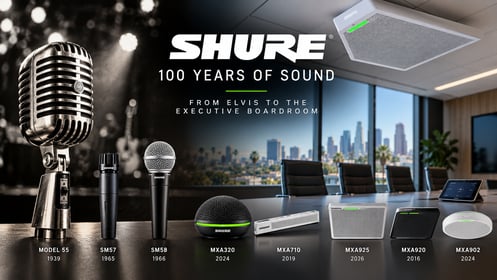
From Elvis to the Executive Boardroom: 100 Years of Shure Microphones
Few names in professional audio have the history and recognition of Shure. From the unmistakable chrome...
Conference Room Automation: A Guide to Smarter Corporate Meeting Spaces
Modern conference rooms are no longer simply spaces with a display, speakers, and a videoconferencing system....
InfoComm 2026: 5 Q-SYS Innovations Shaping Enterprise Collaboration
InfoComm 2026 once again proved why it remains the premier event for commercial audiovisual technology. While...